Fork vs upstream
rengwu/wayfinder-maps stops where the decisions stop: a map is done when the way is clear, and the build happens somewhere else. This fork lets a map carry on into implementation, so the whole journey lives in one graph. A map with no implement tickets reads exactly as it does upstream.
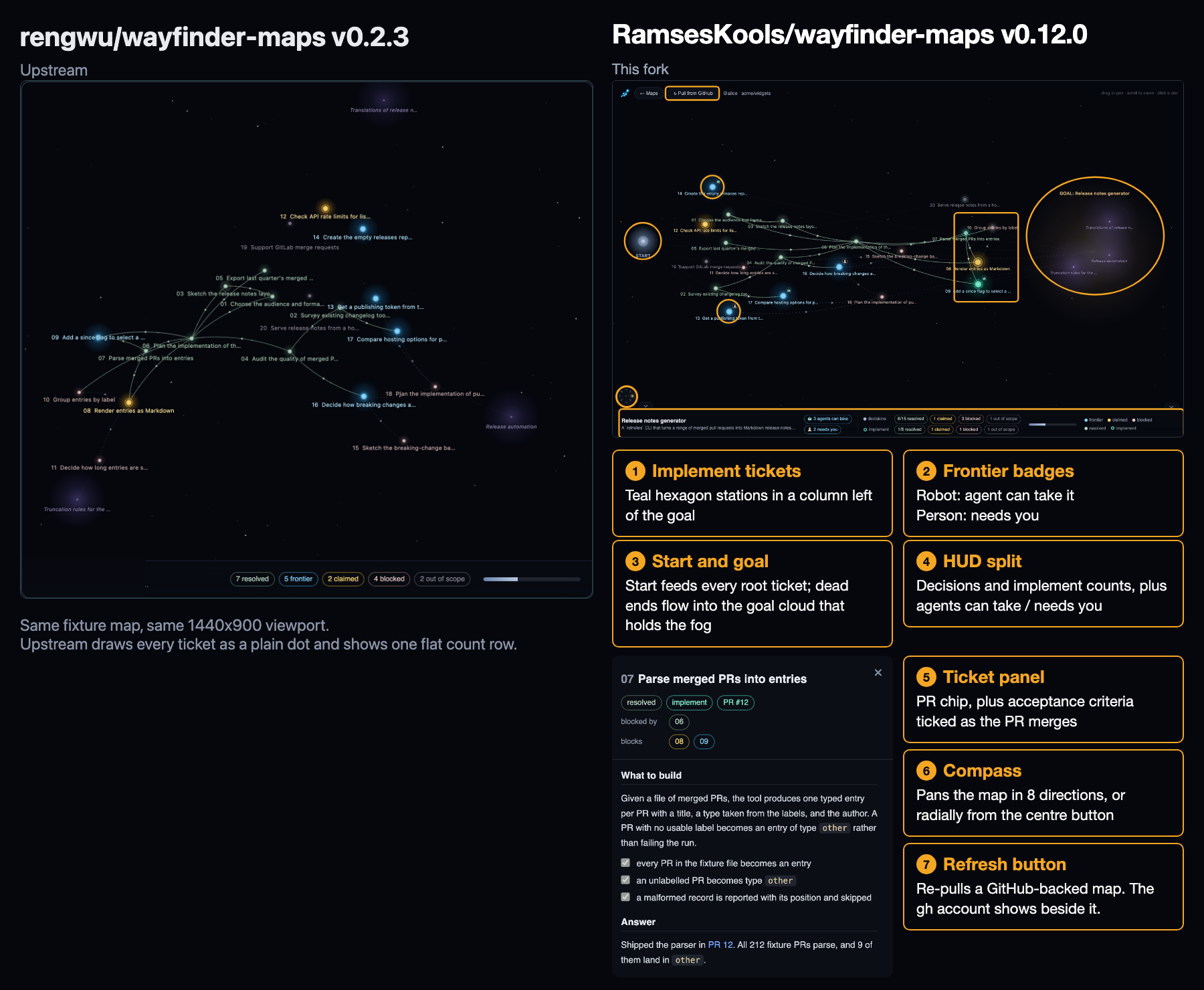
What this fork adds
| Addition | What it gives you |
|---|---|
implement tickets |
Shipped work lives on the map, with an optional PR link |
| AFK or HITL frontier | Each ready ticket says whether an agent can take it |
Split status, lint, graph JSON |
Decisions and implementation counted apart |
| Start and goal in the viewer | A virtual start and a goal cloud holding the fog |
| Compass | The map flows in any of 8 directions or radially |
| Tickets placed by age | Later tickets drift toward the goal without stretching the map |
| Settings menu | A gear popover for viewer toggles with hover notes, saved across restarts; Freeze nodes stops the idle drift of the stars, Update check turns the outdated notice on or off, gh account sets the default account for pulls |
| Narrow-screen layout | Wrapping top bar and a status bar that collapses to a corner, its fold tab always beside the compass |
pull in the binary |
GitHub-issue maps mirrored into .plan/, with account choice and progress |
| Refresh button | The same pull from the viewer |
| Open from GitHub | Find a map in a repo and open it from the splash, with account choice, no pull first |
| Recent maps | Maps opened from the CLI or the viewer are listed on the splash |
install-skill |
Skills embedded in the binary, installed per harness |
self-update |
The binary upgrades itself |
| Outdated notice | A short stderr notice with the right update command when a newer release exists, and the latest version in the settings menu; cached for a day and easy to silence |
| Logo | A small constellation as the favicon, the splash logo and the mark on the map |
--version |
On wayfinder-maps and the Linux webview helper |
The design record has the full plan for the implement phase.
Why these additions
Wayfinder exists because planning and deciding don't always fit in one session. I think the same holds for implementation:
- Some of the fog only clears once you start building. An implementation regularly turns up new questions that need a grilling, research or a prototype, and those belong on the same map rather than in a fresh plan.
- I like tracking progress on the visual map, and an implementation too big for one session deserves that view as well.
So one map now tracks the decisions and the implementation, all the way until the work is done.